Archives ""

Quantum’s year to shine? 2025 marks a defining moment for investment and impact

UNESCO’s International Year of Quantum Science and Technology (IYQ) sets the stage for 2025 to be quantum’s most defining year yet. But is the industry ready for take-off? Where is the smart money going, and which sectors will drive real adoption?

The signs are already there. Quantum tech development this year is going to keep attracting commercial and financial interest. We’ve already seen the likes of Google, Microsoft, and JPMorgan Chase ramp-up their quantum ambitions, with Google’s Quantum AI team backing QuEra’s neutral atom platform and Microsoft pushing its Azure Quantum Elements initiative.

Meanwhile, Nvidia’s Jensen Huang downplayed quantum’s immediate impact, arguing it’s still too niche compared to AI. But as 2025 unfolds, could Huang’s scepticism be tested?

Here we’ve put together some recent stats to illustrate how the quantum market is evolving. We’ve also converted US dollars to UK sterling using a rate of $1 to £0.88 where relevant.
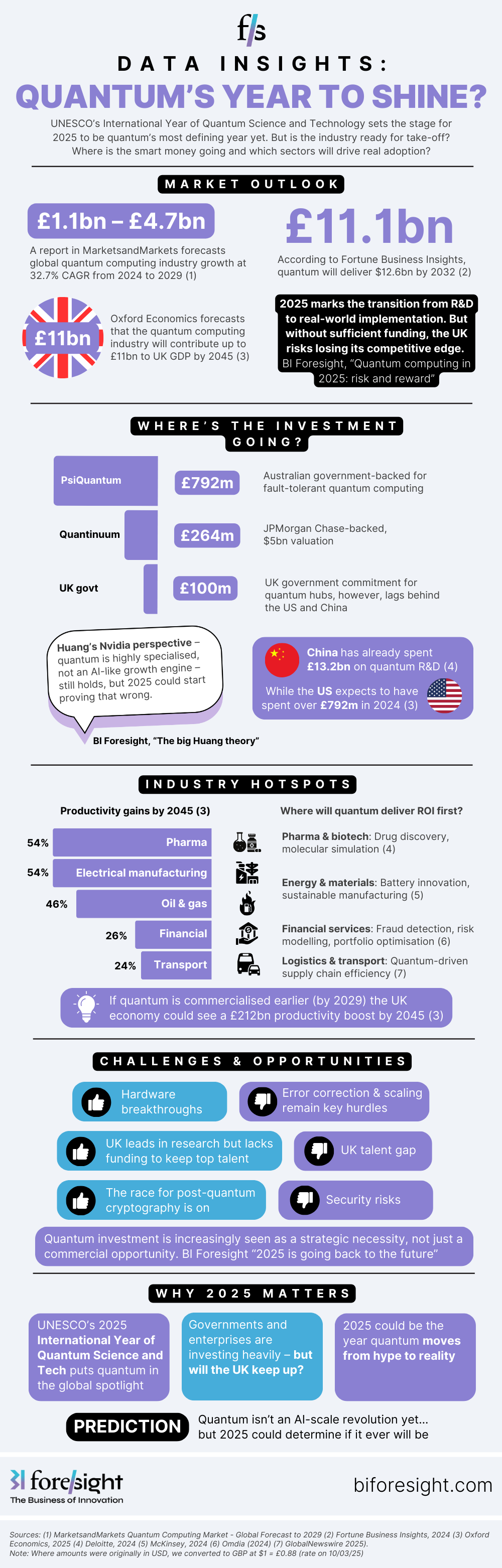
An infographic giving the following information: DATA Insights: Quantum’s year to shine? UNESCO’s International Year of Quantum Science and Technology sets the stage for 2025 to be quantum’s most defining year yet. But is the industry ready for take-off? Where is the smart money going and which sectors will drive real adoption? Market outlook £1.1bn – £4.7bn A report in MarketsandMarkets forecasts global quantum computing industry growth at 32.7% CAGR from 2024 to 2029 (1) £11bn Oxford Economics forecasts that the quantum computing industry will contribute up to £11bn to UK GDP by 2045 (3) £11.1bn According to Fortune Business Insights, quantum will deliver $12.6bn by 2032 (2) 2025 marks the transition from R&D to real-world implementation. But without sufficient funding, the UK risks losing its competitive edge. BI Foresight, “Quantum computing in 2025: risk and reward” Where’s the investment going? PsiQuantum – £792m (Australian government-backed for fault-tolerant quantum computing) Quantinuum – £264m (JPMorgan Chase-backed, $5bn valuation) UK government – £100m (UK government commitment for quantum hubs, however, lags behind the US and China) China has already spent £13.2bn on quantum R&D (4) While the US expects to have spent over £792m in 2024 (3) Huang’s Nvidia perspective – quantum is highly specialised, not an AI-like growth engine – still holds, but 2025 could start proving that wrong. BI Foresight, “The big Huang theory” Industry hotspots Productivity gains by 2045 (3) Pharma 54% Electrical manufacturing 54% Oil & gas 46% Financial 26% Transport 24% Where will quantum deliver ROI first? Pharma & biotech: Drug discovery, molecular simulation (4) Energy & materials: Battery innovation, sustainable manufacturing (5) Financial services: Fraud detection, risk modelling, portfolio optimisation (6) Logistics & transport: Quantum-driven supply chain efficiency (7) If quantum is commercialised earlier (by 2029) the UK economy could see a £212bn productivity boost by 2045 (3) Challenges & Opportunities + Hardware breakthroughs + UK leads in research but lacks funding to keep top talent + The race for post-quantum cryptography is on - Error correction & scaling remain key hurdles - UK talent gap - Security risks Quantum investment is increasingly seen as a strategic necessity, not just a commercial opportunity. BI Foresight “2025 is going back to the future” Why 2025 matters UNESCO’s 2025 International Year of Quantum Science and Tech puts quantum in the global spotlight Governments and enterprises are investing heavily – but will the UK keep up? 2025 could be the year quantum moves from hype to reality PREDICTION Quantum isn’t an AI-scale revolution yet… but 2025 could determine if it ever will be References Sources: (1) MarketsandMarkets Quantum Computing Market - Global Forecast to 2029 (2) Fortune Business Insights, 2024 (3) Oxford Economics, 2025 (4) Deloitte, 2024 (5) McKinsey, 2024 (6) Omdia (2024) (7) GlobalNewswire 2025). Note: Where amounts were originally in USD, we converted to GBP at $1 = £0.88 (rate on 10/03/25)

Title

BI Foresight

Section

Read on

Click me

The big Huang theory: were the Nvidia CEO’s quantum comments wrong?

Nvidia CEO Jensen Huang, sporting a Tom Ford shiny black leather jacket, rattled the financial markets and tech commentators last week with his claim that very useful quantum computers are 15 to 30 years away. Speaking at CES 2025 in Las Vegas, Huang praised the potential of quantum computing but emphasised the significant challenges in scaling the technology to practical, fault-tolerant systems.

While many in the quantum community agree with Huang’s realism, others believe his timeline overlooks the substantial advancements already being made in the field. Industry leaders, academics and analysts have provided valuable context to Huang’s remarks, highlighting both the long-term challenges and the near-term opportunities.

Title

BI Foresight

Section

Read on

Click me

How to grow a quantum start-up. ORCA Computing co-founder on pragmatism

There’s a lot to be said for challenging a stereotype. Richard Murray, co-founder and CEO of ORCA Computing is on stage at a recent Economist Impact Commercialising Quantum event in London. He’s a confident, relaxed speaker and has already referred to doing “cool stuff” with photonics. He goes on to speak about new customers, such as the Montana State University (MSU), and the need to “go outside” with quantum – out of the lab and into the real world.

It’s a far cry from the pervasive quantum computing image – a fledgling industry still dominated by theory, and (mainly) men in research labs. The event was a good illustration of where the industry currently sits and there are some promising signs of progress, as we revealed in our recent write-up of the event. As well as the likes of IBM, Google, Nvidia and Microsoft, there are a few start-ups leading the hardware charge (Alice & Bob, Pasqal, QuEra and Atom Computing, for example) and ORCA is certainly among the frontrunners.

Title

BI Foresight

Section

Read on

Click me

UK’s quantum computing industry needs investment in talent, says techUK CEO

“How do you get a quantum literate workforce within the broader tech sector?” asks Julian David, CEO of UK technology trade association techUK for more than ten years. “How do you get people to understand and be empowered to utilise quantum technologies or applications?”

This echoes the sentiment of many a country tasked with navigating complex innovation and turning research ideas into business opportunities. While it’s still relatively early days for a quantum applications industry, David’s point is that we have to improve the country’s overall technology competency level to have any chance of grasping the opportunities that quantum will inevitably bring.

“The UK government needs to keep focusing on the skill gaps,” says David. “If you want a quantum strategy, it’s not just about putting money up and encouraging people to get the latest tech, it’s also about investing in all this stuff around it, particularly skills and talents.”

Title

BI Foresight

Section

Read on

Click me