Archives ""

Aerospace reignited: how innovation is taking off to meet govt targets

In November 2024, UK prime minister Keir Starmer announced a £975 million funding commitment to the Aerospace Technology Institute Programme over five years, signalling a renewed government focus on innovation, regional growth, and economic security. That message was reinforced in April 2025 with a broader £13.9 billion R&D package spanning aerospace, AI, and advanced manufacturing. Together, these moves underline the government’s view of aerospace as a strategic growth sector, not just for exports, but for national resilience and global competitiveness.

Once seen as too capital-intensive and risk-heavy for many investors, the sector is now at the forefront of deep tech progress, backed by soaring government budgets, dual-use defence urgency, and the rapid maturing of technologies like AI, advanced materials, and quantum computing.

“The two drivers for the industry as a whole are defence and space,” says Wil Benton, venture partner at Aerospace Xelerated, a global accelerator backed by Boeing, Rolls-Royce, and others. “Defence is where most of the budget is, and space is obviously the new cool thing.”

But what does this really mean for start-ups, innovators working within university labs and the larger corporations already established within these industries? As geopolitical pressures mount and the post-war mindset gives way to a more prepared footing, governments are pushing hard on innovation. And Benton, who is based in Vienna, sees a shift. “Europe is now starting to recognise we can’t just be living in a comfortable post-war situation,” he says. “We’ve got to be prepping for a pre-war situation.”

It certainly looks as though this thinking is fuelling a rise in innovation and in particular, dual-use start-ups – those building tech with both civil and defence applications in mind. Overcoming preconceptions has been part of this process.

“Six years ago, start-ups wouldn’t come out and say they were building defence companies,” says Benton. “Now we’re seeing companies identify as dual-use or defence-focused. It’s more palatable.”

Geopolitics has certainly had a lot to do with that, but even then it’s been something of a culture leap. That said, the growing convergence of technologies, such as AI, robotics and telecoms, is shaping these industries more than ever, which could help recruitment, certainly in terms of attracting younger talent.

This shift from cultural hesitation to strategic alignment is now being formalised through structured support programmes that help start-ups navigate aerospace’s complex regulatory and supply chain environments.

Start-ups that make it into Aerospace Xelerated’s programme undergo rigorous onboarding, including becoming Boeing suppliers before the programme even begins. “Becoming a supplier can be a one-to-five-year process. It’s very slow and expensive,” says Benton. “We do the heavy lifting so corporates and start-ups can just focus on working together.”

Title

BI Foresight

Section

Read on

Click me

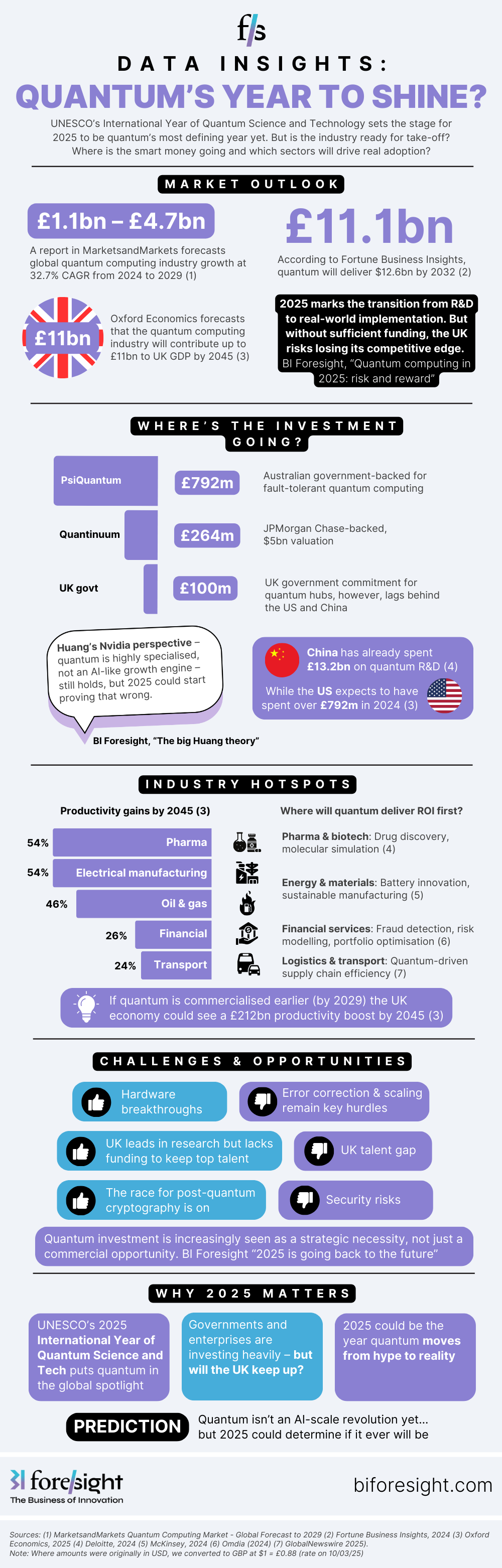
Quantum’s year to shine? 2025 marks a defining moment for investment and impact

UNESCO’s International Year of Quantum Science and Technology (IYQ) sets the stage for 2025 to be quantum’s most defining year yet. But is the industry ready for take-off? Where is the smart money going, and which sectors will drive real adoption?

The signs are already there. Quantum tech development this year is going to keep attracting commercial and financial interest. We’ve already seen the likes of Google, Microsoft, and JPMorgan Chase ramp-up their quantum ambitions, with Google’s Quantum AI team backing QuEra’s neutral atom platform and Microsoft pushing its Azure Quantum Elements initiative.

Meanwhile, Nvidia’s Jensen Huang downplayed quantum’s immediate impact, arguing it’s still too niche compared to AI. But as 2025 unfolds, could Huang’s scepticism be tested?

Here we’ve put together some recent stats to illustrate how the quantum market is evolving. We’ve also converted US dollars to UK sterling using a rate of $1 to £0.88 where relevant.

An infographic giving the following information: DATA Insights: Quantum’s year to shine? UNESCO’s International Year of Quantum Science and Technology sets the stage for 2025 to be quantum’s most defining year yet. But is the industry ready for take-off? Where is the smart money going and which sectors will drive real adoption? Market outlook £1.1bn – £4.7bn A report in MarketsandMarkets forecasts global quantum computing industry growth at 32.7% CAGR from 2024 to 2029 (1) £11bn Oxford Economics forecasts that the quantum computing industry will contribute up to £11bn to UK GDP by 2045 (3) £11.1bn According to Fortune Business Insights, quantum will deliver $12.6bn by 2032 (2) 2025 marks the transition from R&D to real-world implementation. But without sufficient funding, the UK risks losing its competitive edge. BI Foresight, “Quantum computing in 2025: risk and reward” Where’s the investment going? PsiQuantum – £792m (Australian government-backed for fault-tolerant quantum computing) Quantinuum – £264m (JPMorgan Chase-backed, $5bn valuation) UK government – £100m (UK government commitment for quantum hubs, however, lags behind the US and China) China has already spent £13.2bn on quantum R&D (4) While the US expects to have spent over £792m in 2024 (3) Huang’s Nvidia perspective – quantum is highly specialised, not an AI-like growth engine – still holds, but 2025 could start proving that wrong. BI Foresight, “The big Huang theory” Industry hotspots Productivity gains by 2045 (3) Pharma 54% Electrical manufacturing 54% Oil & gas 46% Financial 26% Transport 24% Where will quantum deliver ROI first? Pharma & biotech: Drug discovery, molecular simulation (4) Energy & materials: Battery innovation, sustainable manufacturing (5) Financial services: Fraud detection, risk modelling, portfolio optimisation (6) Logistics & transport: Quantum-driven supply chain efficiency (7) If quantum is commercialised earlier (by 2029) the UK economy could see a £212bn productivity boost by 2045 (3) Challenges & Opportunities + Hardware breakthroughs + UK leads in research but lacks funding to keep top talent + The race for post-quantum cryptography is on - Error correction & scaling remain key hurdles - UK talent gap - Security risks Quantum investment is increasingly seen as a strategic necessity, not just a commercial opportunity. BI Foresight “2025 is going back to the future” Why 2025 matters UNESCO’s 2025 International Year of Quantum Science and Tech puts quantum in the global spotlight Governments and enterprises are investing heavily – but will the UK keep up? 2025 could be the year quantum moves from hype to reality PREDICTION Quantum isn’t an AI-scale revolution yet… but 2025 could determine if it ever will be References Sources: (1) MarketsandMarkets Quantum Computing Market - Global Forecast to 2029 (2) Fortune Business Insights, 2024 (3) Oxford Economics, 2025 (4) Deloitte, 2024 (5) McKinsey, 2024 (6) Omdia (2024) (7) GlobalNewswire 2025). Note: Where amounts were originally in USD, we converted to GBP at $1 = £0.88 (rate on 10/03/25)

Title

BI Foresight

Section

Read on

Click me

How to grow a quantum start-up. ORCA Computing co-founder on pragmatism

There’s a lot to be said for challenging a stereotype. Richard Murray, co-founder and CEO of ORCA Computing is on stage at a recent Economist Impact Commercialising Quantum event in London. He’s a confident, relaxed speaker and has already referred to doing “cool stuff” with photonics. He goes on to speak about new customers, such as the Montana State University (MSU), and the need to “go outside” with quantum – out of the lab and into the real world.

It’s a far cry from the pervasive quantum computing image – a fledgling industry still dominated by theory, and (mainly) men in research labs. The event was a good illustration of where the industry currently sits and there are some promising signs of progress, as we revealed in our recent write-up of the event. As well as the likes of IBM, Google, Nvidia and Microsoft, there are a few start-ups leading the hardware charge (Alice & Bob, Pasqal, QuEra and Atom Computing, for example) and ORCA is certainly among the frontrunners.

Title

BI Foresight

Section

Read on

Click me